
The Data Centre Rating Measures The Building, Not The Cloud
The EU data centre rating will score facilities above 500 kW on energy, water and grid contribution from 2027. It rates buildings, not cloud services. What that means for cloud and AI procurement, and three questions to put to your provider now.
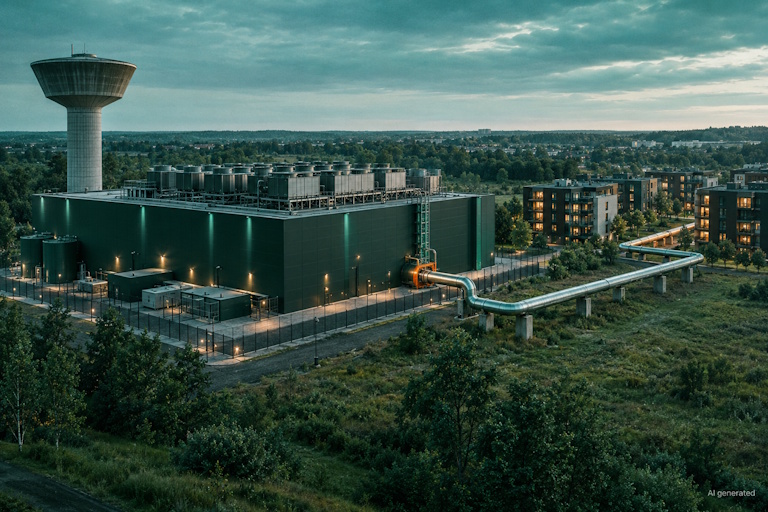
Brussels wants to know how much energy and water your cloud uses. Your cloud provider may not tell you which building that is.
On 21 September, the European Commission proposed a common data centre rating for every facility in the EU with a capacity above 500 kW. The scheme will make the actual use of energy and water transparent. It will also cover each site’s contribution to the grid, such as the reuse of waste heat, the addition of clean generation capacity and flexibility. The first labels are expected in 2027.
That sounds like a problem for data centre operators. It is also a procurement question for anyone who buys cloud or AI services.
What the data centre rating measures
The Commission’s reasoning is about scale. According to the International Energy Agency figures it cites, data centres consumed around 68 TWh of EU electricity in 2024. Driven by artificial intelligence, that is expected to reach 114 TWh by 2030, more than 3% of total EU electricity demand. Meanwhile, the EU wants to triple its data centre capacity over the next five to seven years.
The data centre rating builds on the reporting that operators already owe under the Energy Efficiency Directive and the 2024 reporting scheme for data centres. What changes is the output. Reported figures become a rating, and the rating becomes a label that can be displayed for an individual site.
The Commission frames this as transparency rather than restriction. Nobody is told to close a facility. Instead, facilities become comparable on the same terms, which is exactly what a buyer has lacked.
What it does not measure
The data centre rating scores a building. It does not score a cloud service, a model or your workload.
That distinction matters more than it first appears. If your contract names a region rather than a building, the label will not reach you unaided. A region can span several facilities. AWS, for example, builds each region from several availability zones, each consisting of one or more separate data centres.
In September we wrote that compute sovereignty is not about where the building is. For sovereignty, the address is not the point. Here, the address is the whole point.
Where the data centre rating meets your procurement
For the AI lead, the useful question is not whether the scheme is good policy. It is whether the data centre rating will ever appear in a document you control.
Check your own vendor questionnaire. If it covers security certifications, data location and subprocessors but not which facilities run the workload, the label may exist in 2027 and still never reach the person who signs the contract.
That would be a waste, because the data centre rating is useful precisely because it is comparable. Two providers quoting the same region can run it from facilities that rate differently. Until now, there was no common rating to compare them on.
The fix is cheap and can start now. We have written before about how sovereignty levels change the way you buy cloud and AI. The data centre rating adds a parallel line to the same questionnaire.
Three questions for your provider
For each significant cloud or AI contract, three questions do the work:
- Which facilities host our workloads, and do they fall under the scheme? A region is not an answer. A list of sites, or a commitment to provide one, is.
- Will you share the facility labels once they exist? Ask as well how you will hear about it when a workload moves to a differently rated site.
- How do the facilities we use handle waste heat, water and grid flexibility? These are the grid-side elements the Commission says the rating will cover.
None of these questions commits you to anything. However, a provider that cannot answer the first one tells you something about how much visibility you have over your own infrastructure.
Timing and what can still change
The proposal is a delegated regulation, so the European Parliament and the Council have a two-month scrutiny period. They can object to the act, but they cannot amend its text. If neither objects, the regulation enters into force and the first labels follow in 2027. The Commission has also scheduled a first review of the scheme by the end of 2028.
A separate track deserves attention. Alongside the rating, the Commission opened a call for evidence and a public consultation on minimum performance standards for data centres, which closes on 14 December 2026. That is a different kind of instrument. A label informs the buyer. A minimum standard would decide which facilities qualify at all.
For a buyer, the two work in sequence. The data centre rating tells you how your providers compare. Any future standard could change which of them can still operate the way they do today.
Energy is no longer a line item that belongs only to the provider. The Commission’s energy commissioner, Dan Jørgensen, tied digital sovereignty to energy responsibility in the same announcement.
The question for your next renewal
The data centre rating will not choose your provider for you. It gives you a fact you did not have before, provided you ask for it.
So the question for your next cloud or AI renewal is short. Do you know which buildings run your workloads, and would your provider tell you if you asked?
If you want a structured way to work through vendor questions like these, the Future Prep free account gives you free assessments and checklists.

Bas Hennis
Future Prep helps organizations prepare for the impact of AI and emerging technologies. We provide hands-on training, strategic advice, and smart tools for the responsible use of AI, governance, and digital resilience.LinkedIn
Newsletter
Related Blogs
LATEST NEWS
AI governance is not a future problem
Regulation is already in effect. Your competitors are already building internal capability. The gap between ‘we are aware of AI’ and ‘we have operational control’ is closing, and it closes faster with a structured framework.
Book a 30-minute discovery call. No obligation. We will assess where your organisation stands and what a realistic starting point looks like.
No sales pressure. No jargon. Just a structured conversation about your organisation's AI readiness.