
The data centre backlash and your AI bill
Opponents won almost every one of 41 local data centre ballot measures in the US midterms. Analysts now expect slower buildout and higher grid costs. For a European firm running AI on US infrastructure, data centre capacity has become a question of dependence. Four questions to put to suppliers.
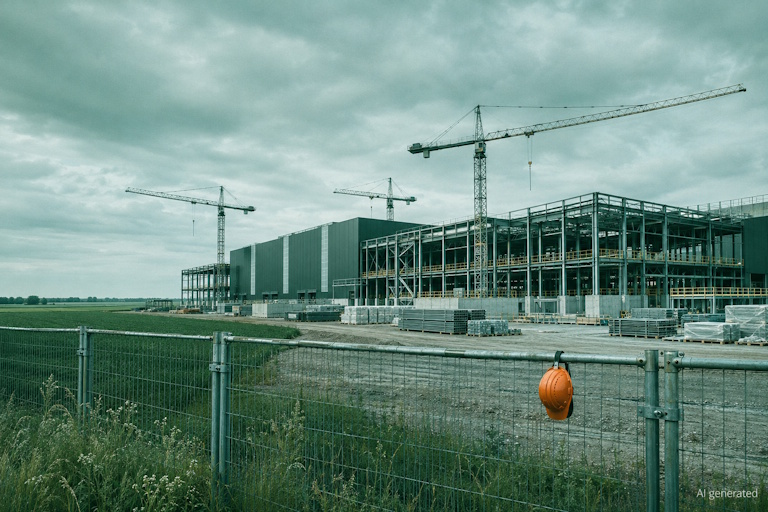
American voters were asked about data centres in 41 local ballot measures on 3 November. Opponents won almost everywhere. For a European firm whose AI runs on American infrastructure, that result raises a plain commercial question about data centre capacity: how much of it will exist, where and at what price.
This is the third piece in a series on the US midterms and AI. The first covered the rules and the second the suppliers behind the tools you use. This one follows the electricity cable.
What voters decided on data centres
Ballotpedia counted 41 local measures on data centre policy across ten states. A yes vote on 28 of them would limit development, through bans, six-month moratoria, zoning rules or voter-approval requirements. The other 13 would make development easier.
According to PYMNTS, preliminary results showed opponents prevailing in virtually all of them, though some votes were advisory.
Ohio carried more than half the measures, and a good share of the fight over future data centre capacity. Fortune reports 21 measures in 18 municipalities, with at least 14 passing bans or other restrictions. Ohio also has more than 125 active local moratoriums on data centres. Nationally, Fortune cites a Gallup poll from May in which about 70% of Americans opposed data centres in their local area.
The opposition is not confined to one party. Political scientists quoted by Fortune describe the scepticism as bipartisan. In an Ohio poll, the environment was the top reason for opposition, followed by quality of life and the economy. Ben Green of the University of Michigan told Fortune that massive corporations operating in secrecy and giving communities no voice is unpopular across parties.
Why data centre capacity is now a political question
Local votes matter because they decide where new data centre capacity can go. Analysts have started to put numbers on that. UBS strategists, quoted by Fox Business, wrote that “data center pauses will slow the pace of buildout into 2028.” They put about 30% of expected 2028 additions at risk, with 18 gigawatts of that in Texas alone. They also expect data centres to pay more often for grid upgrades, which could raise costs.
Ray Wang of Constellation Research told TechTarget he expects “at least six months when data center approvals get slowed down.” In his words, projects that once needed little scrutiny now face “so much regulatory red tape.”
Congress is not the main actor here. State Street analysts, also quoted by Fox Business, noted that “congressional control alone would not be enough to curtail AI-related data center construction,” given the presidential veto. The decisions sit with towns, counties and states.
Not the end of AI spending
None of this means the money stops. The same State Street analysts wrote that tougher scrutiny “should not automatically be equated with an end to the AI capital spending cycle.” They expect AI investment to stay strong in 2027, tempered by supply chain strain and tighter credit.
So the likely effect on data centre capacity is friction, not a halt. Projects take longer, cost more and move to places that still want them. For buyers, friction is still a cost. It shows up later and less visibly than a ban would.
What it means for dependence on US technology
For a mid-market firm in Europe, the link is indirect but real. If your AI services run on a US provider, their price and availability depend partly on how fast that provider can add data centre capacity. That capacity is now subject to local politics in a way it was not a year ago.
Your own workloads may well run in a European region. The models behind them, and the capacity used to train and serve them, may not. When a supplier faces slower buildout and higher grid costs, those pressures can surface in pricing, in waiting lists for new features or in which regions get a service first. That is an inference, not a forecast, but it is the kind of exposure a sovereignty discussion should start from.
Kashyap Kompella of RPA2AI Research told TechTarget that companies making large AI commitments need to weigh “regulatory certainty, energy availability and infrastructure resilience.” That list applies to buyers as much as to builders.
Questions on data centre capacity for your suppliers
Dependence becomes manageable once you can describe it. You do not need inside knowledge of a hyperscaler’s building plans to ask about data centre capacity. Four questions get most of the way there.
- In which regions do the services you rely on run, and where does the underlying model capacity sit?
- What does the supplier commit to if new capacity arrives late?
- Does the contract allow price changes linked to energy or grid costs?
- What would it take to move a critical workload to another provider or region?
The answers will not remove the dependence. They will tell you how much data centre capacity risk you are carrying and whether anyone has priced it.
Sovereignty without the slogans
Digital sovereignty debates can sound like a choice between American platforms and European ones. The data centre votes suggest a more useful framing. Infrastructure is becoming a local political question, and constraints on data centre capacity in one country travel through the supply chain to customers in another.
For an AI lead, the task is the same as with any concentrated supplier risk: know where it sits, know what it would cost if it moved, and decide in advance what you would do. That is less dramatic than a migration plan and considerably more useful.
That closes this series on the midterms and AI. The rules will take time, the suppliers will be questioned and the capacity may cost more to build. A clear view of your own position is worth more than a prediction about any of the three.
To see where your governance stands today, the free AI Governance Readiness Assessment shows the weakest areas to address first.

Bas Hennis
Future Prep helps organizations prepare for the impact of AI and emerging technologies. We provide hands-on training, strategic advice, and smart tools for the responsible use of AI, governance, and digital resilience.LinkedIn
Newsletter
Related Blogs
LATEST NEWS
AI governance is not a future problem
Regulation is already in effect. Your competitors are already building internal capability. The gap between ‘we are aware of AI’ and ‘we have operational control’ is closing, and it closes faster with a structured framework.
Book a 30-minute discovery call. No obligation. We will assess where your organisation stands and what a realistic starting point looks like.
No sales pressure. No jargon. Just a structured conversation about your organisation's AI readiness.