
The EU AI sovereignty model is moving toward a hybrid approach. It combines binding rules with shared, federated infrastructure that is meant to stay open to global technology while reducing dependency risks. For SMEs and mid-market leaders, this matters because AI choices increasingly look like location and ecosystem decisions, not just tool selections. The practical questions are where your data sits, which compute you rely on, which models you deploy, and whether your governance can satisfy customers in regulated sectors and public procurement.
What “hybrid AI sovereignty” means in practice
Hybrid sovereignty is not about building every layer in Europe from scratch. It is about shaping a European baseline for trust, safety, and accountability while expanding access to infrastructure and reusable components that European firms can adopt without full vendor lock-in.
In practice, this model has two pillars. First, it uses binding regulation to set expectations for risk management, documentation, and oversight. Second, it aims to expand shared capacity through cooperative mechanisms such as federated cloud projects, EuroHPC-backed compute access, and support for open and interoperable AI building blocks.
For SMEs, the key shift is that compliance and infrastructure are converging. A vendor’s governance features, hosting options, audit support, and model transparency start to matter as much as raw performance.
Why regulation and infrastructure are being linked
The EU’s logic is that rules alone do not deliver competitiveness. If SMEs cannot access compute, data spaces, and testing environments, only the largest firms can ship compliant AI at scale. The hybrid model therefore pairs governance requirements with public and public-private investment in compute and innovation capacity.
This also reflects how AI is built and delivered. The stack crosses chips, energy, data centres, cloud services, models, and applications. A credible sovereignty agenda must therefore address both obligations and enabling infrastructure.
The regulatory pillar: AI Act governance and possible simplification
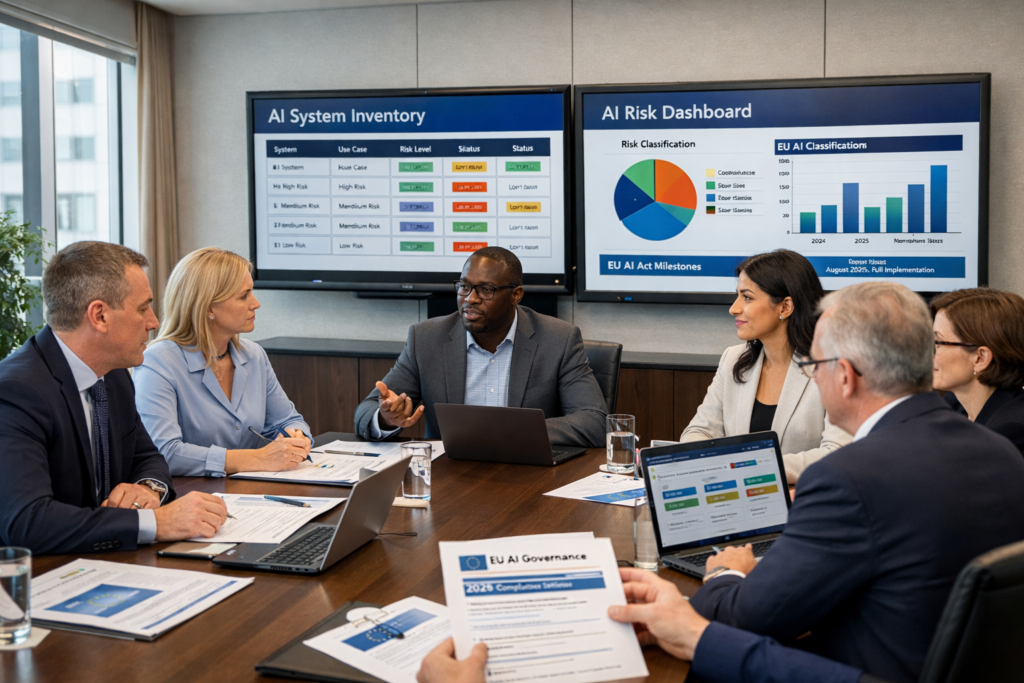
The AI Act is designed to set obligations based on risk, with tighter requirements for high-risk systems. For management teams, the most important point is that governance needs to become operational. It cannot remain a one-off legal review.
Governance under the EU AI sovereignty model typically touches product design, procurement, HR, and security. You will likely need clear ownership, training, documentation discipline, and a repeatable process for assessing use cases that involve personal data, automated decision-making, or safety-critical environments.
At the same time, policy debates in Brussels are exploring simplification and timing adjustments. Proposals grouped under a digital “omnibus” approach have been discussed as a way to reduce burden for smaller firms and better align implementation with the availability of standards, guidance, and oversight capacity. If timelines shift, that does not remove the direction of travel. Buyers in regulated industries will still demand evidence that your AI is governed, tested, and monitored.
What SMEs should do now, even if timelines move
If you wait for final implementation details, you risk building systems that are expensive to retrofit. Instead, focus on a minimal governance spine that improves quality today and scales later:
- define AI use-case categories and approval paths
- require supplier documentation for models and data processing
- set testing and monitoring expectations before deployment
- align HR processes for training, acceptable use, and escalation
This is not only about legal exposure. It is about winning deals where customers want proof of control and accountability.
The infrastructure pillar: AI Factories, Gigafactories, and shared compute
Alongside regulation, the EU is scaling compute access and support structures. AI Factories are intended to help startups and SMEs access AI-optimised supercomputing capacity, expertise, and services. The policy goal is to expand Europe’s available compute and reduce barriers to experimentation and scaling.
The EU is also advancing larger-scale compute concepts often described as AI “Gigafactories”. These are designed as world-class AI compute infrastructures, typically framed as public-private efforts that can support European competitiveness while keeping access pathways for startups and scale-ups.
For SMEs, the opportunity is not just cheaper compute. It is the potential to test, fine-tune, and validate models in environments that align better with European governance expectations and procurement norms. This can matter when your customers require EU-based processing, clearer security assurances, or predictable audit support.
Federated cloud and edge-cloud as building blocks
Europe’s hybrid approach also emphasises federated infrastructure. Instead of one central “EU cloud,” the idea is to connect providers through common rules, interoperability, and shared assurance mechanisms. Federated cloud efforts and edge-cloud initiatives aim to support data locality, resilience, and portability without forcing a single vendor model.
From a strategy view, this supports a “globally connected but controllable” posture. You can still use global tools where appropriate, while reserving certain workloads, data sets, or customer deployments for EU-anchored infrastructure.
Strategy impact for EU SMEs and mid-market management
This hybrid sovereignty trajectory changes how AI strategy should be framed. It is no longer enough to choose a model and integrate an API. You should treat AI as a portfolio of deployments with different risk levels, infrastructure needs, and customer expectations.
The most practical management question is how to balance speed with control. Many firms will run a mixed setup: global platforms for low-risk productivity, and EU-anchored options for sensitive workloads or regulated customers. Over time, procurement and customer due diligence will make this split more explicit.
A useful way to structure decisions is to evaluate each AI use case across four dimensions: data sensitivity, customer and sector expectations, operational dependency risk, and governance readiness. This helps you decide when an EU-anchored stack is a competitive advantage rather than a constraint.
To act early without overcommitting, aim for small pilots that build organisational capability. Test open or interoperable model options, explore federated cloud or edge deployments where latency and locality matter, and build a repeatable governance workflow that your teams can follow.
If your growth depends on public-sector work, cross-border deals, or regulated industries, early alignment with the EU AI sovereignty model can reduce sales friction and improve trust. The winners are likely to be firms that make AI governable and portable, not just powerful.
Start by mapping your AI use cases to risk, infrastructure, and customer expectations this quarter.